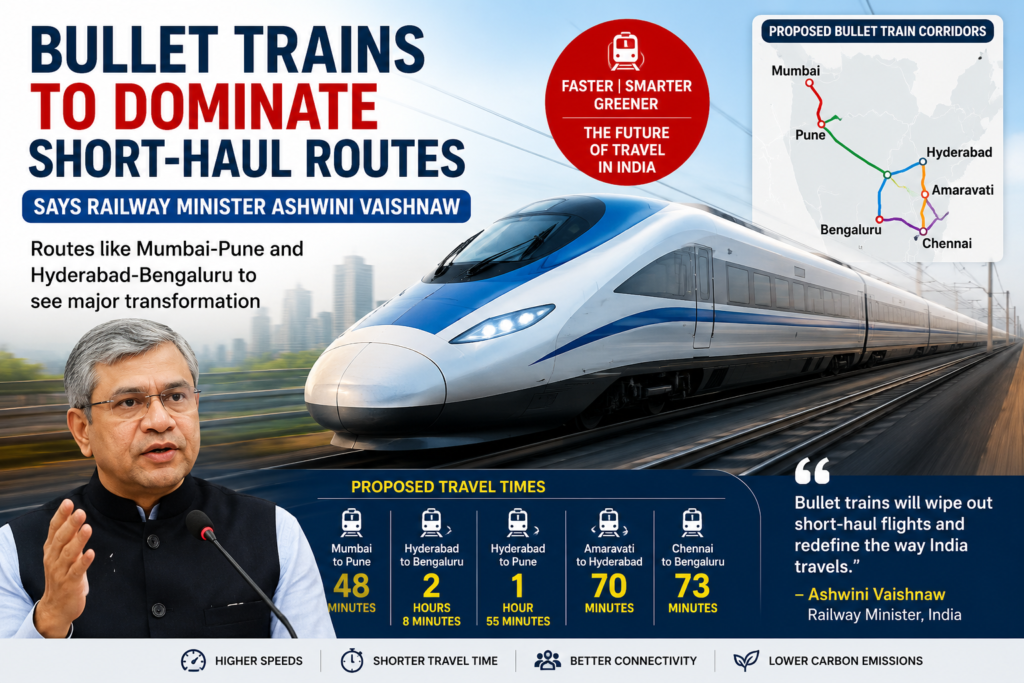
🚆 Bullet Trains May Replace Short-Haul Flights in India, Says Railway Minister Ashwini Vaishnaw
Published on: May 11, 2026 Category: Railway / Travel News Author: FlipMyTravel Editorial Team
Overview
Union Railway Minister Ashwini Vaishnaw has said India’s upcoming bullet train corridors could dominate short-distance travel routes such as Mumbai–Pune and Hyderabad–Bengaluru, significantly impacting domestic airline traffic. The minister highlighted that India’s expanding high-speed rail network aims to drastically reduce travel time while improving regional connectivity and economic integration.
Discover Headline
“Flights May Lose Their Edge”: Ashwini Vaishnaw Says Bullet Trains Will Transform Travel Between Mumbai, Pune, Hyderabad & Bengaluru
India’s transportation future may soon shift from airports to ultra-fast railway corridors. Railway Minister Ashwini Vaishnaw has indicated that upcoming bullet train routes could become the preferred option for millions of travellers on short-haul routes currently dominated by airlines.
Bullet Trains Could Redefine Domestic Travel in India
Speaking about India’s ambitious high-speed rail expansion, Railway Minister Ashwini Vaishnaw stated that bullet trains are expected to “wipe out” or heavily disrupt short-haul airline routes in the coming years.
The minister specifically highlighted routes like:
Mumbai → Pune
Hyderabad → Bengaluru
Hyderabad → Pune
Amaravati → Hyderabad
Chennai → Bengaluru
According to the government’s proposed “High-Speed Diamond” rail network, travel times on these corridors could reduce dramatically.
Proposed Bullet Train Travel Times
Major Planned High-Speed Rail Corridors
Route
Expected Travel Time
Mumbai → Pune
48 minutes
Hyderabad → Bengaluru
2 hours 8 minutes
Hyderabad → Pune
1 hour 55 minutes
Amaravati → Hyderabad
70 minutes
Chennai → Bengaluru
73 minutes
These timings could directly challenge airline travel when airport check-ins, security procedures, and city-to-airport travel are considered.
Why Bullet Trains Could Beat Flights
India’s railway ministry believes high-speed rail can become more convenient than flights for short and medium-distance travel because of:
Faster city-center to city-center connectivity
Reduced airport waiting time
Seamless multimodal transport integration
Lower carbon emissions
Better passenger comfort for short-distance journeys
The government is also planning integrated transit-oriented developments around future bullet train stations to improve urban mobility.
Hyderabad–Bengaluru Corridor Gains Attention
Among the proposed corridors, the Hyderabad to Bengaluru bullet train project is emerging as one of South India’s most important future routes.
The planned corridor is expected to connect the two technology hubs in nearly two hours, compared to current rail journeys that can take 10 – 14 hours and flight journeys that often extend due to airport transit and delays.
The project may also integrate with future Mumbai to Hyderabad high-speed rail connectivity, creating a larger western-southern high-speed network.
India’s Bullet Train Expansion Accelerating
The Railway Ministry says India is currently constructing nearly 15 km of bullet train track every month.
The Mumbai–Ahmedabad Bullet Train corridor remains India’s first operational high-speed rail project under development, while several additional corridors are now being planned under the Union Budget 2026–27 expansion roadmap.
Minister Ashwini Vaishnaw also announced that India’s indigenous “Vande Bullet” prototype is expected by 2027.
Travel Insight for FlipMyTravel Readers
If India successfully develops these high-speed rail corridors, domestic travel patterns could change significantly over the next decade.
For travellers, this could mean:
Faster weekend business travel
Reduced airport dependency
Easier intercity commuting
More sustainable transport options
Growth in tourism across connected cities
Routes like Hyderabad to Bengaluru and Mumbai to Pune may especially see a shift toward same-day rail travel once bullet train services become operational.
FAQs
Which routes were mentioned by Ashwini Vaishnaw?
The minister highlighted routes including Mumbai–Pune, Hyderabad–Bengaluru, Hyderabad–Pune, Amaravati–Hyderabad, and Chennai–Bengaluru.
How fast will Mumbai to Pune bullet train travel be?
The proposed travel time is expected to be around 48 minutes.
Will bullet trains affect domestic airlines?
Yes. Ashwini Vaishnaw said high-speed rail could heavily impact short-haul airline routes in India.
Is the Hyderabad–Bengaluru bullet train confirmed?
The corridor is currently proposed and part of India’s broader high-speed rail expansion plans.
When will India launch its Vande Bullet train?
The government expects the Vande Bullet prototype rollout in 2027.
Latest Explore Travel Guides Best Hill Stations in India for Peaceful Travel (2026 Guide) February 22, 2026 Travel Guides Quiet Mountains, Fresh Air & Relaxing Nature Escapes for Stress-Free Holidays “Peace is not… Read More Travel Guides Best Time to Visit Kerala (2026): Weather, Festivals & Smart Travel Tips February 22, 2026 Travel Guides Complete […]

 English
 Dutch
Dutch Japanese
 Korean
 Chinese